
Quote a control panel without leaving money on the table
How to quote a control panel: an eight-step checklist for panel shops
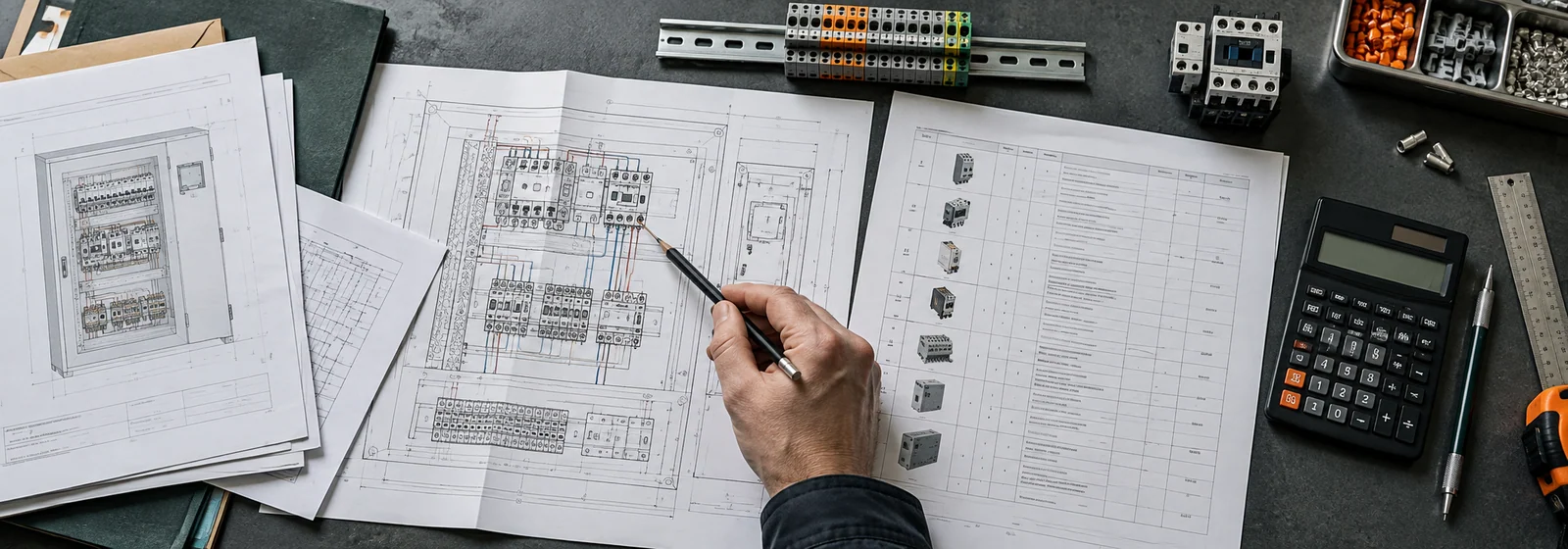
To quote a control panel, work through eight steps: confirm the RFQ is complete, build and price the bill of materials, estimate engineering and build labour, add testing and commissioning, add incidentals and contingency, add overhead and margin, state your assumptions, exclusions and validity, and have a second person review it before it goes out.
- Most quoting errors start before pricing: an incomplete RFQ is the biggest hidden risk, so score the package first.
- Price every BOM line with a lead time as well as a cost, then state how long the quote is valid.
- Labour rules of thumb vary by about three times between sources, so calibrate against your own completed jobs.
- Write assumptions and exclusions into the quote. They are what protect margin when scope changes.
- A second-person review checklist catches the expensive mistakes cheaply.
A control panel quote is a small engineering project done at speed. You have a handful of drawings, an I/O list or a bill of materials from the customer, a delivery date, and usually a competitor quoting the same job. The shops that win consistently are not always the cheapest. They are the ones that respond quickly, quote completely and protect their margin with clear assumptions. This guide sets out a repeatable eight-step method, with a printable checklist at the end, so that every quote leaves your shop built the same way.
Why a repeatable quoting process matters
Speed matters, and so does accuracy. One 2026 benchmark roundup from HumCommerce, a vendor of quoting automation, reports an average of 24 to 72 hours to respond to a quote request across manufacturers and distributors, and 48 to 120 hours for custom or configured products where engineering review is needed. The same article estimates that building a standard quote by hand takes 40 to 75 minutes, with pricing lookups, inventory checks and margin calculations making up most of that time. It also cites a Proposify analysis of nearly two million sales proposals in which responses inside four hours closed 35 percent more often than responses after 24 hours. Treat those numbers with care: the source sells quoting software, and the Proposify data covers proposals in general rather than panel RFQs specifically. The direction is still useful. Fast, complete responses help, and a standard process is what makes them possible without cutting corners.
Eight steps, with a human review at the end.
- 1Check the RFQIs the package complete before you price?
- 2Price the BOMEvery line, with a lead time
- 3Estimate labourEngineering and build hours
- 4Add test and docsTesting, paperwork, commissioning
- 5Add contingencyOnly for risks you can name
- 6Add overhead and marginMargin is calculated on price
- 7Write the quoteState assumptions, exclusions, validity
- 8Second-person reviewA second person signs off before it goes out
Orange marks the decision point: nothing goes to the customer until a second person has checked it.
Step 1: Check that the RFQ is complete before you price anything
Every hour spent pricing an incomplete package is a risk. Before you open a spreadsheet, check what the customer has actually sent. A completed package makes your estimate far more reliable; a sketch makes it a guess. One estimating guide from Industrial Monitor Direct suggests applying a documentation-completeness factor to build labour: 1.00 for a complete package, rising to about 1.30 where only a sketch exists, with a range of 0.85 to 1.30 overall. Whatever factor you use, the principle is to make incomplete documentation visible in the price.
RFQ completeness checklist
- Electrical schematics or a clear functional description, and the revision they are at
- A bill of materials or I/O list, with customer-supplied parts identified
- Enclosure type and environment (indoor, washdown, hazardous area), including the required enclosure rating
- Supply voltage, phases, frequency, and the available fault current at the installation site
- The standards the panel must meet, such as UL 508A and NFPA 79, and whether a listing mark is required
- Testing, factory acceptance and commissioning requirements
- Documentation deliverables: as-built drawings, wire lists, manuals, test reports
- Required delivery date and any phased shipping
- Labelling, language and nameplate requirements
- Payment terms and who owns long-lead component risk
If more than two or three of these are missing, ask the customer before quoting, or quote with an explicit documentation contingency. For UL 508A work, the available fault current matters especially, because the short-circuit current rating of the finished panel is marked on the nameplate and has to be at least what the site can deliver. See our UL 508A documentation checklist for how that figure drives design and records.
Step 2: Build and price the bill of materials
Start with a line-by-line bill of materials. For each line, record the part number, quantity, unit cost, supplier and, just as important, the current lead time. A price without a lead time is half a quote, because a component that takes 30 weeks changes the whole delivery promise. Check each part against what the specification requires: a component that is not suitable for the standard or the environment is an expensive surprise after award.
Add allowances for what will not appear on the schematic. The same Industrial Monitor Direct guide suggests allowing 5 to 10 percent waste on wire and 2 to 3 percent on terminals, plus a freight and sourcing allowance, and incidentals such as ferrules, duct, labels and nameplates at around 8 to 12 percent of component cost for typical panels, and 12 to 18 percent for high-density or safety-rated panels. Those are starting points to be replaced by your own history. If you track actual consumable spend per job, use that.
Be wary of multiplier shortcuts. The same guide notes that doubling component cost is a rough budgetary rule at best, and that treating it as a final price quietly assumes a zero gross margin once labour is counted. Use multipliers to sanity-check a detailed estimate, never to replace it.
Step 3: Estimate engineering and build labour
Labour is where panel quotes diverge most, and where published rules of thumb disagree. One guide suggests about 5 minutes per digital point and 10 minutes per analog point for an experienced technician working from a kitted shop; another suggests 15 to 30 minutes per I/O point for wiring and termination, plus extra for networks, grounding and documentation. A 100-point PLC system, it notes, can involve 200 or more individual wire connections once power and networks are counted. These figures differ by roughly three times, which is the real lesson: nobody else's number is your number.
Build your own. Record estimated and actual hours by task on every job, and after 15 to 20 jobs you will have calibrated averages for your people, your layout style and your tooling. In the meantime, use a function-based approach: classify the panel (single-drive starter, multi-drive, process control, safety-rated multi-node) and apply the labour budget from similar completed jobs. Add engineering time separately. If you have to reverse-engineer schematics into interconnects, one source suggests adding 15 to 30 percent to engineering labour.
Step 4: Add testing, documentation and commissioning
These are the line items most often forgotten, and the ones that quietly consume margin. Include functional testing, any high-potential or insulation tests your process requires, factory acceptance testing if the customer will witness it, preparation of the document pack, and commissioning support. Commissioning is a known overrun risk: one guide suggests allowing 1.5 to 2 times the estimated time for complex systems. As a sense of proportion, the cost split it reports for control panel projects is roughly 30 to 50 percent power components, 15 to 30 percent engineering labour, 15 to 35 percent panel build labour and 5 to 15 percent commissioning and factory acceptance testing. If your own split looks very different from that range, check your assumptions before you send the price.
Reported project-cost ranges: a reference, not a costing rule.
Share of total project cost (%)
Source: one estimating guide (Industrial Monitor Direct). The ranges overlap, so they do not add up to 100%. Use them to sanity-check an estimate, then calibrate against your own jobs. Orange: the largest reported share.
Step 5: Add contingency for the risks you can name
Contingency should be specific, not a vague percentage. Name the risks and price the ones that apply: incomplete documentation, long-lead or allocated components, a customer who is known to change scope, a new technology or first-article build, and tight commissioning windows. Where a component is on a long lead time, quote a validity period short enough that you are not carrying the price risk, and consider naming a pre-approved substitute. Our guide to BOM-to-purchase-order checks and lead-time risk sets out how to code each line by supply risk so that this step takes minutes, not hours.
Step 6: Add overhead and margin, and do the maths correctly
Overhead covers the costs of running the shop that no single job pays for directly. Then comes margin. The most common slip at this stage is confusing markup with margin. Markup is measured against cost; gross margin is measured against price. A 25 percent markup produces a 20 percent gross margin, not 25. To reach a target gross margin, divide cost by one minus the margin: a job costing $80 needs a price of $100 to earn a 20 percent margin, and $106.67 to earn 25 percent. Our control panel cost estimating guide covers the arithmetic in full.
Step 7: Write the quote so that scope is protected
A quote is a document of assumptions as much as a price. State the revision of the drawings and BOM you priced against, what the quote excludes (site work, customer-supplied components, third-party testing, freight if applicable), the lead time and how it is conditional on component availability, the validity period, payment terms, and how changes will be handled. A clear change policy is what turns later drawing revisions into a priced variation instead of an argument. For the mechanics of managing those changes, see our guide to the engineering change order process.
Step 8: Have a second person review it
Review is the cheapest quality control you have. Another estimator, or an engineer who did not build the quote, should check the totals, the assumptions and the exclusions against the RFQ. Give the reviewer a short checklist so that the review is consistent.
Second-person quote review checklist
- Drawing and BOM revisions on the quote match the revisions received
- Every BOM line has a price, a supplier and a lead time; none is blank or marked "TBC" without a note
- Quantities reconcile between schematic, BOM and layout
- Labour hours are within about 20 percent of similar completed jobs, or the difference is explained
- Testing, documentation and commissioning are included or explicitly excluded
- Overhead and margin are applied in the right order, with margin calculated on price
- Long-lead items have a risk note and a validity period that protects the shop
- Assumptions, exclusions, payment terms and change policy are on the quote
- The total, lead time and validity date agree with the cover email
Where automation fits
Most of the time in a quote goes into reading the package, extracting the lines and looking up prices, not into judgement. That is the part that can be prepared by software, with the estimator reviewing, correcting and approving the result. If you are interested in what that looks like in a panel shop, our quote preparation workflow turns an RFQ into a reviewed BOM and a priced draft with an exception list, on your own past quotes first. Or start from the Steady Rabbit AI practice overview.
Frequently asked questions
How long should it take to quote a control panel?
It depends on the package. One 2026 benchmark roundup reports 48 to 120 hours to respond on custom or configured products and 40 to 75 minutes of hands-on effort for a standard quote built manually. A complete RFQ and a calibrated labour database are what bring that down. Treat vendor benchmarks as a guide, not a target.
What should be included in a control panel quote?
Include a priced bill of materials with lead times, engineering and build labour, testing and factory acceptance, documentation, commissioning support if required, incidentals, contingency, overhead and margin. State the drawing revision priced, exclusions, delivery terms, payment terms, the validity period and how changes will be handled.
How do you estimate labour for a control panel build?
Start from a function-based budget or a per-point time, then replace both with your own data. Published rules of thumb range from about 5 to 10 minutes per digital or analog point up to 15 to 30 minutes per I/O point, so calibrate using estimated versus actual hours from your last 15 to 20 jobs.
What information do I need from a customer to quote a panel?
You need schematics or a functional description, a BOM or I/O list, enclosure type and environment, supply voltage and available fault current, applicable standards such as UL 508A, testing and documentation requirements, delivery date and labelling requirements. If several are missing, ask or add a documentation contingency to the price.
How long should a control panel quote stay valid?
Match validity to your supplier price holds and lead times, not to a standard 30 days. When key components are on long lead times or allocation, a shorter validity period or a stated right to reprice protects you from price and availability movement between quote and order.
Why do control panel quotes go wrong?
The usual causes are incomplete RFQs, missing line items for testing and commissioning, labour estimated from someone else's rule of thumb, markup confused with margin, and no review step. A fixed checklist and a second reviewer address most of them.
Sources
- HumCommerce: How Long Should a B2B Quote Take? Benchmarks for Manufacturers and Distributors — Vendor article. Quote turnaround benchmarks and the Proposify 35 percent figure, with the caveats noted above.
- Industrial Monitor Direct: Control Panel Cost Estimating, Labor and Material Methods — Vendor knowledge base. Labour heuristics, waste and incidental allowances, documentation factor and cost split.
- Industrial Monitor Direct: Control Panel Wiring Labor Time Estimation Methods — Vendor knowledge base. Per-I/O time range and commissioning multiplier.
- Entrepreneur: Understanding the Difference between Gross Margin and Markup — Definitions and the 25 percent markup to 20 percent margin conversion.
- Unitechnik: UL 508A Explained — SCCR must appear on the nameplate and depends on the available fault current at the site.
Prepared by the Steady Rabbit AI team from the published sources above. Figures and ranges from third parties are as reported by them and are not Steady Rabbit measurements. This is general information, not engineering, legal or compliance advice. Check current requirements and supplier data for your own jobs.
Where this fits in our workflows.
More guides for panel shops.
 Estimating · 6 min read
A 25% markup is not a 25% margin. Price your panels correctly
See why a 25% markup is not a 25% margin, and how to build the cost, markup and margin layers correctly.
Read the guide ↗ AI and quoting · 6 min read
Don’t buy AI quoting software until you’ve run this test
Test AI quoting software on your own past quotes, not a vendor demo, and see which one holds up before you commit.
Read the guide ↗ Purchasing · 6 min read
Check the BOM against the PO before the wrong part is ordered
Compare the BOM, the quote and the purchase order line by line, so the wrong part is caught before it is ordered.
Read the guide ↗