
Check the BOM against the PO before the wrong part is ordered
BOM-to-purchase-order checks and lead-time risk: a checklist for panel shops
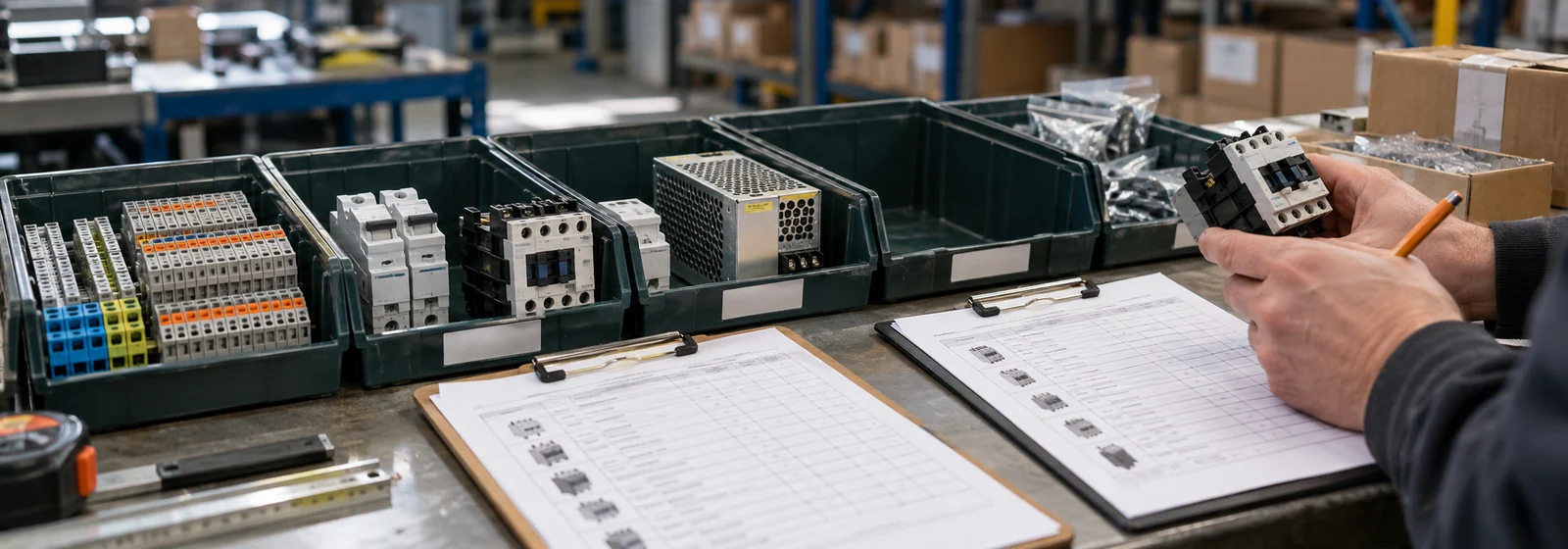
Before a purchase order is released, check it against the current bill of materials for part number, quantity, revision and supplier, and against the quote for price and lead time. Code each BOM line by supply risk, order long-lead items first, and record substitutes in advance so a delay becomes a planned change, not a surprise.
- A purchase order is a copy of a BOM at a point in time. If the BOM changes, the order is already out of date.
- Check three things before release: BOM versus PO, PO versus quote price, and every line's current lead time.
- Code each line by supply risk and decide the mitigation before you order, not after the delay.
- Component lead times and landed costs have moved sharply, so quotes need validity periods that reflect supply risk.
- Substituting a controller or drive is engineering work, not a purchasing swap. Plan it in advance.
The purchase order is where a quote becomes real money. Until then, a wrong quantity or a superseded part number is a spreadsheet error. After release it is freight, restocking fees, idle labour or a missed ship date. For a custom panel shop, which buys dozens of different components for each job, the last check before ordering is one of the cheapest places in the business to catch mistakes. This guide sets out what to check, how to code lines by supply risk, and how to keep quotes honest when lead times and costs are moving.
Why the check matters: errors travel
OpenBOM, a BOM management vendor, groups common bill of materials errors into quantity mistakes, missing components, costing that is done too late, requirements that engineering, production and procurement do not share, and regulatory requirements lost between engineering and purchasing. It notes that late-discovered errors are expensive because the design is complete and parts are already ordered. A purchasing check is the point at which most of those errors can still be fixed for the price of an email. Research on engineer-to-order companies makes a related point: engineering changes spread into purchasing and production, but those teams are often brought in only after approval. Checking the BOM against the order at release is the habit that closes that gap.
Three comparisons to make before a purchase order is released.
- 1BOM against purchase orderSame parts, quantities and revisionExample exceptionPO line asks for 4; the BOM needs 6
- 2Purchase order against the quoteUnit prices still match what the quote costing assumedExample exceptionContactor now ordered above the price in the quote
- 3Every line against current supplyStock, price and lead time confirmed today (dated input)Example exceptionBreaker lead time is 26 weeks; the quote assumed 8
Comparing a BOM with a purchase order
| Line | BOM part | BOM qty | PO part | PO qty |
|---|---|---|---|---|
| 10 | A-1100 | 2 | A-1100 | 2 |
| 11 | A-1204 | 4 | A-1204 | 3 |
| 12 | A-1315 | 6 | A-1351 | 6 |
Line 11: quantity short. Line 12: part reference differs. Whether a part is suitable is an engineering decision.
Part references, quantities and lead times in the examples are invented for illustration.
The pre-release checklist
Before you release a purchase order
- The BOM revision on the order matches the current released revision for the job
- Every part number on the order exists on the BOM, and every BOM line to be bought appears on an order
- Quantities reconcile, including waste allowances, spares and customer-supplied items
- Supplier, pack sizes and minimum order quantities are correct and unit prices match the quote or an approved update
- Each line has a confirmed lead time from the supplier or an authorised distributor, not an assumption
- The promised delivery date still works once the longest lead time is taken into account
- Parts meet the specification and any listing requirement, so a cheaper or alternative part has not slipped in unchecked
- Alternates and substitutes are approved by engineering and, where needed, the customer
- The order is released against a frozen BOM, and any later change will go through change control
Lead times: what the published figures show, and what they do not
Lead times are the part of the check that has changed most. Industrial Monitor Direct, a vendor knowledge base, publishes field-reported ranges for control components, with the caveat that they are not manufacturer ship dates and should be confirmed with an authorised distributor at the time of the RFQ. Its table includes, for example, 30 to 52 weeks for some PowerFlex drives, 20 to 40 weeks for Siemens S7-1200 CPUs, 20 to 40 weeks for ABB ACS580 and ACS880 drives, 16 to 26 weeks for B-rated miniature circuit breakers, 12 to 20 weeks for 4PDT relay sockets and 8 to 16 weeks for Mitsubishi MELSEC. The article reflects conditions around 2021 to 2023, so read the figures as an illustration of how wide the spread can be between components in a single panel, not as current quotes.
Field-reported lead times varied widely between parts in one panel.
Historical example: 2021 to 2023. Not current quotes.Weeks
Source: one vendor knowledge-base guide describing 2021 to 2023 conditions, as reported by that vendor. Orange: upper end of the range above 26 weeks. Always confirm current figures with an authorised distributor.
The wider picture in 2026 is also unsettled. Frontier Electric Supply, an electrical distributor, reported in a 2026 industry briefing that top-category semiconductor lead times reached 40 weeks in March 2026, up from 20 to 25 weeks through most of 2025, and that tariffs and logistics had pushed landed costs on some products sharply higher, giving as examples an estimated 15 to 30 percent increase on motor starters, advanced protection relays and industrial UPS systems, depending on where the semiconductors and assemblies originate. These are a distributor's estimates and will vary by product and source, but they point in a consistent direction: prices and lead times can move between quote and order, so a quote needs a validity period and a repricing policy that reflect that.
Code every BOM line by supply risk
The Industrial Monitor Direct guide recommends tagging each BOM line A to D by number of sources and lead time, with D covering lines of 26 weeks or more or on allocation. The exact scheme matters less than having one. A simple version looks like this.
| Code | Typical profile | What to do before ordering |
|---|---|---|
| A | Several authorised sources, short lead time | Order at release. No special action. |
| B | Few sources or moderate lead time | Confirm stock and lead time at quote and again at order. |
| C | Single source or long lead time | Order early. Name an approved alternate and note it on the quote. |
| D | Allocated or very long lead time (for example 26 weeks or more) | Agree the BOM with the customer, secure allocation, and treat any slip as a change, not a surprise. |
The same guide advises getting onto a manufacturer's allocation list with a forecast rather than relying on spot purchases, holding accounts with at least two authorised distributors per major brand, and keeping rolling safety stock on the most exposed lines. It also advises locking panel dimensions to a product-family envelope so that a substitute can drop in without redesign, and checking date codes, sealed packaging and traceability on allocated or grey-market parts. Safety components are a special case: it states that substituting them is not permitted under functional safety standards without re-validation.
Substitutes are engineering work
It is tempting to see a substitute controller as a purchasing decision: same function, different brand, shorter lead time. The reality is different. The same guide estimates that moving to a different PLC platform can need a full re-implementation of 40 to 80 engineering hours per controller, and it recommends pre-qualifying one substitute for every PLC, drive, HMI and safety component and documenting it before ordering the original. That turns a delay into a planned alternative with a known cost, and it should be written into the quote as an assumption. Where the panel carries a listing mark, a substitution also has to be reflected in the documentation, as covered in our UL 508A documentation checklist.
Set re-check triggers for open quotes
A quote is a snapshot, and open quotes go stale while customers decide. Rather than reviewing every open quote on a calendar, set triggers that tell you which ones need a second look: a price change on any line above a threshold you choose, a lead-time change on a long-lead line, or a quote approaching the end of its validity period. It helps to know what a price move is worth. As a worked illustration, suppose components are 40 percent of a job's cost and component prices rise 5 percent. Total cost rises 2 percent. On a job priced at a 25 percent gross margin, that cuts profit by about 6 percent, so a modest-looking price move has a bigger effect on profit than on cost. Calibrate your own thresholds from your typical margin and material share, and review them when conditions change.
Keep the quote honest
A purchasing check protects margin only if the quote reflects what it finds. When long-lead lines are identified at quoting, the quote should say so: a shorter validity period, a stated right to reprice if supplier prices move, named alternates and a delivery date conditional on component availability. Our control panel quoting checklist shows where those lines go in the quote, and our cost estimating guide shows how to price the risk.
When drawings change after a purchase order is out, the position depends on how quickly the change reaches purchasing. The process in our engineering change order guide is built to do exactly that.
Where automation fits
The BOM-to-order check is a comparison task: thousands of fields, mostly matching, a handful not. It is slow and dull for a person and quick for software, provided a person reviews the exceptions. Our purchasing checks workflow compares the BOM with the purchase order before parts are ordered and lists the mismatches for your buyer to resolve. The companion price and lead-time alerts flag open quotes whose cost or lead time has moved so that your estimator can decide whether to re-quote. Both are planned workflows within the Steady Rabbit AI practice, shaped with our first design partners.
Frequently asked questions
What is a BOM-to-purchase-order check?
It is a reconciliation done before a purchase order is released: confirm the order matches the current bill of materials for part numbers, quantities, revision and supplier, matches the quote for price, and reflects current lead times. Any mismatch is resolved before parts are ordered, not after they arrive.
How do you reduce purchasing errors in a panel shop?
Order against a frozen, revision-controlled BOM, reconcile every line against the order before release, confirm prices and lead times with suppliers, record approved alternates, and feed drawing changes to purchasing immediately. A short pre-release checklist and a second reviewer catch most errors cheaply.
How long are lead times for PLCs and drives?
They vary widely by product and period. One vendor guide reports field ranges from about 8 to 16 weeks for some PLC families up to 30 to 52 weeks for some drives under 2021 to 2023 conditions. Always confirm current lead times with an authorised distributor when you quote.
How should a quote reflect long-lead components?
Identify long-lead lines at quoting, state a delivery date conditional on component availability, shorten the validity period, name approved alternates, and include a right to reprice if supplier prices move. Agree the BOM with the customer where lines are on allocation.
How do you handle component shortages in control panel builds?
Code BOM lines by supply risk, pre-qualify one substitute for each critical PLC, drive, HMI and safety component, hold accounts with more than one authorised distributor, order long-lead items first, and treat any substitution as an engineering change with documentation updates.
When should purchasing be told about a design change?
Before the change is approved, if possible, and always before orders are placed or amended. Research on engineer-to-order companies finds that purchasing and production are often involved only after approval, which causes rework. Include them in the impact assessment.
Sources
- Industrial Monitor Direct: PLC Component Shortages, Lead Times and Alternative Sourcing — Vendor knowledge base. Field-reported lead times (2021 to 2023 conditions), risk coding, buffer stock, substitutes and engineering effort.
- Frontier Electric Supply: Electrical Component Supply Chain 2026 — Distributor article. 2026 semiconductor lead times and tariff-related cost estimates; figures are the distributor's.
- OpenBOM: What Is the Cost of Bill of Materials (BOM) Mistakes? — Vendor article. Categories of BOM errors and late discovery.
- Springer: Engineering Change Management in the Engineer-to-Order Production Environment — Academic chapter. Purchasing and production involved late in change management.
Prepared by the Steady Rabbit AI team from the published sources above. Figures and ranges from third parties are as reported by them and are not Steady Rabbit measurements. This is general information, not engineering, legal or compliance advice. Check current requirements and supplier data for your own jobs.
Where this fits in our workflows.
More guides for panel shops.
 Quoting · 7 min read
Quote a control panel without leaving money on the table
Eight steps from RFQ check to bill of materials, labour and margin, with a second review before it goes out.
Read the guide ↗ Revisions · 6 min read
One changed line can derail a panel build. Here’s how to catch it
Learn how a formal change order catches every changed line and keeps BOM and drawings aligned.
Read the guide ↗ Estimating · 6 min read
A 25% markup is not a 25% margin. Price your panels correctly
See why a 25% markup is not a 25% margin, and how to build the cost, markup and margin layers correctly.
Read the guide ↗