
From RFQ to a draft quote
your estimator approves.
We organise the RFQ, review the BOM and prepare a priced draft quote with an exception list. Your estimator corrects and approves.

- WE PREPARERFQ inEmails, PDFs, drawings and any partial BOM
- WE PREPAREBOM preparedEvery doubtful line flagged, nothing assumed
- WE PREPAREPriced draftYour prices and rules applied, exceptions listed
- YOUR ESTIMATORYou approveNothing reaches a customer without your estimator’s sign-off
Six jobs hide
behind one email.
Pick a step to see what really happens, where it quietly goes wrong, and what that costs you.
Understand the ask
The RFQ arrives as an email with PDFs, a marked-up drawing, a spec sheet and sometimes a customer BOM. The estimator works out voltage and supply, the enclosure and its environment, who supplies what, which standards the customer expects, and the delivery date.
Scope is assumed instead of confirmed. A requirement buried in a customer specification, such as a listing or a preferred brand, is found only after the price has gone out.
Preparation time with nothing to show for it, and no easy way to tell which RFQs deserve the effort.
Build the BOM
Read the drawings, list every device, and type the parts into Excel. Then add what the drawing never shows: terminal blocks, wire, ferrules, duct, DIN rail, labels, nameplates and hardware.
The small items are forgotten, and they add up. A part number is mistyped. A substitute is chosen quietly and never mentioned.
Margin lost on a job you won, or an urgent order and freight while the panel is already in build.
Price it
Prices come from distributor quotes, price lists or the last order. Long-lead items such as drives, breakers and enclosures need a call or an email, because one item often decides the delivery date.
A stale price goes into a fresh quote. A long lead time is found after the customer has already been promised a date.
A job won at a price you can no longer buy at, or a job lost because you padded every quote to be safe.
Estimate the hours
Layout, drilling, mounting, wiring, testing, drawings and documentation are converted into labour. In most shops this comes from the experience of one or two senior people, not from a written method.
Documentation and testing time are under-counted. The estimate is only as good as one person’s memory, and only that person can do it.
Slow replies. Customers often go with whoever answers first, and your best person spends their time on data entry.
Check the rating
Does the job need to be built to UL 508A? What short-circuit current rating must the panel carry, given the supply it will be connected to? Are the components and the enclosure suitable for that rating and the environment?
The panel’s rating can be limited by its lowest-rated power component. If the site’s available fault current was never stated, the question comes back after the quote, as a redesign or a change of parts.
Higher-rated parts or upstream protection added after the price is agreed, and a late change to the design.
Review and revise
Someone senior reviews the numbers, adds margin and terms, and sends the quote. Then the customer changes a quantity, a part or a drawing, and much of the work starts again.
The revision is carried into the price but not into the BOM, or the other way round. Quotes wait in a queue behind the one person who can finish them.
A scope dispute after the order, or a price that no longer matches what is being built.
What does quoting
cost your shop?
Example numbers are filled in. Replace them with yours. Nothing is sent or stored.
This is what your current process costs, not a promise of savings. The pilot measures what you would actually save on your own quotes.
A pilot measures what actually changes.
Measure it on your own quotes ↗Four steps.
One person signs off.
We take the preparation on. Your estimator keeps the decision. Try it on the mock-up: click through the four steps, or pick one.
- Your data stays yours, under an NDA
- You keep your own tools and price files
- A person approves every quote
An illustration with made-up parts and prices. Your own version is set up around your files and quote rules.
One clear job summary.
We gather the RFQ emails, PDFs, drawings and any supplied BOM into one source-linked summary. What is missing becomes a question, not an assumption.
Every doubtful line flagged.
We prepare the BOM from what is supplied and flag every line we are unsure of. Where a drawing is the only source, those lines are marked for your estimator to check.
A draft quote and exceptions.
Using your price files and quote rules, we prepare a draft quote and an exception list: missing prices, unapproved substitutions and open questions.
A person signs off.
Your estimator reviews, corrects and approves. Nothing reaches a customer without a person’s sign-off.
We prove drawing-reading on your own drawings before you rely on it.
A 4–6 week pilot on your own work.
A subscription only once it is proven.
We agree the scope and the definition of done, and sign the NDA together. We run the pilot on your own data and keep refining it until it meets that definition. Your annual subscription starts only after you sign off the result.
- 01START · AGREE THE SCOPE
Agreed up front, in writing.
We sign the NDA and agree the scope together: one workflow, the success measures and exactly what done looks like. Only then do any drawings or prices change hands.
- 02DURING · 4–6 WEEK PILOT
On your own data.
We run the pilot beside your live work, so nothing you rely on changes. About 10 past RFQs run in shadow mode, with the quotes you actually sent as the reference.
- 03END · SIGN-OFF
Refined until it meets the bar.
A short report against the success measures you set. If it falls short, we refine and run it again until it meets the definition of done.
- 04AFTER · SUBSCRIPTION
Starts at sign-off.
One annual subscription per workflow covers running it, support and improvements. You already know it works on your own data, so this is not an experiment.
How you are protected. The pilot has a bounded scope and success measures agreed before it starts. Concerns about your data, or about how our two teams will work together, are tested against those measures. At the end you decide whether to go on, and the subscription starts only after you sign off.
Why panel shops
work with us.
Your data stays yours. The workflow gets better every year, for you and for everyone we work with.
Your data stays yours
Your drawings, prices and quotes are covered by the NDA and are never shared with other shops. Access, storage and deletion are agreed up front.
You get the best of every shop
What we learn about the work itself, the common gaps and the checks that catch them, goes back into the product. You benefit from it without anyone seeing your data.
It keeps getting better
We keep refining the format, the checks and the results throughout the year. Improvements to your workflow are included in your subscription.
You see it work first
The pilot runs on your own quotes against a definition of done you set. You subscribe once you have signed off the result.
We run it. You decide.
We set it up, run it and support it. Your estimator reviews and approves everything that reaches a customer.
Built by AI product engineers
AI product engineering is what we do every day, and that craft goes into your workflow: the design, the testing and the support.
The checks an estimator
wants, on every RFQ.
The questions an experienced estimator asks, written down and asked every time. Each one produces a flag or a question for your people, never a silent decision.
CompletenessNothing on the drawing gets left off.4 checks
- Every device on the drawing has a line in the BOM
- Quantities on the BOM reconcile with the counts on the drawing
- An incidentals line is present: wire, ferrules, terminals, duct, DIN rail, labels, hardware
- Anything the RFQ mentions but the BOM lacks is listed as open
ConsistencyParts, ratings and supply agree.4 checks
- Part number, description and brand agree on each line
- Voltage, phase and current ratings agree across the components and with the stated supply
- The same part is not listed twice under different numbers
- Substitutions are shown beside the part asked for, never swapped quietly
Price and lead timeEvery price dated, every delay named.4 checks
- Each price shows its source and its date
- Prices older than your own rule are flagged
- Each line carries a lead time, and the longest one is named as the driver of the delivery date
- Lines with no price are listed, not filled in with a guess
Requirements to confirmStandards questions asked early.4 checks
- Does the RFQ call for UL 508A, and is that stated clearly?
- Is the available fault current at the panel’s supply given?
- Is the enclosure type and environment stated?
- Each of these becomes a question for your qualified person to answer
RevisionsOnly what changed is repriced.4 checks
- A revised RFQ is compared with the previous one on the same job
- Added, removed and changed lines are listed with the reason found
- The priced draft is updated only for the lines that changed
- The earlier version stays on file for comparison
Labour and documentationYour rules, applied the same way every time.3 checks
- Your own labour rules are applied the same way every time
- Documentation, testing and drawings are counted as lines, not forgotten
- Anything outside your rules is flagged for the estimator to price by hand
Tap a card to see the checks.
What a flag looks like · sample
Terminal blocks, 2.5 mm²
The drawing shows 62 terminations. The BOM lists 48. 14 are not accounted for.
Line 22 · Contactor
The price is from a quote dated before your 60-day rule. Please re-confirm.
Supply fault current
The RFQ does not state the available fault current. Panel rating cannot be confirmed. Ask the customer.
What we will not do · boundaries we keep, on purpose
Scope, input, output and boundaries
RFQ emails, PDFs, drawings and any supplied BOM
A source-linked job summary, a reviewed BOM and a priced draft quote with an exception list
Your estimator reviews, corrects and approves the quote
About 10 past RFQs run in shadow mode, with the quotes you actually sent as the reference.
BOM lines matched to your quote, lines flagged for review, preparation and review time, and handling of exceptions.
A drawing alone may not contain a complete BOM. Ambiguous symbols, missing specifications and inferred parts stay open for qualified review. Reading drawings is tested on your own drawings in the pilot, not assumed. A person approves the final customer quote.
What buyers ask
before they start.
How does AI turn an RFQ into a draft quote?
We read the RFQ package you receive, such as the email, PDFs, drawings and BOM spreadsheets, pull out the BOM lines, match them to your price files and assemble a priced draft in your own quote format. Every line it is unsure of is flagged. Your estimator reviews the draft before anything goes further.
Can AI read panel drawings and scanned PDFs?
Not everything. Clean PDFs and structured BOMs are the easiest. Hand-marked scans and unusual drawing conventions are harder. The pilot shows where the line sits for your shop, and anything it cannot read is flagged, not guessed.
How accurate is AI quote preparation on our own jobs?
We measure it, line by line, on your past drawings and quotes, and show you exactly where review is needed. You agree the success measures before the pilot starts. A pilot typically takes 4 to 6 weeks, with the scope and the definition of done agreed in writing.
Do we have to replace our ERP, CAD tool or quoting spreadsheet?
No. We start from the files you already use: RFQ emails, PDFs, drawings, BOM spreadsheets and price files. Integrations come later, and only if they make sense.
Will our customer drawings and price lists stay confidential?
We sign an NDA before any drawings or prices are shared, and agree access, storage, retention and deletion up front. Your drawings and prices are never shared with other shops.
Does the estimator still approve the quote and own the final price?
Yes. Your estimator reviews, corrects and approves, and sets the price. Nothing reaches a customer without a person’s sign-off.
See what it could take
off your team.
A 20-minute call. We listen first, walk you through it, and tell you whether it fits. No drawings needed.
Guides behind this workflow.
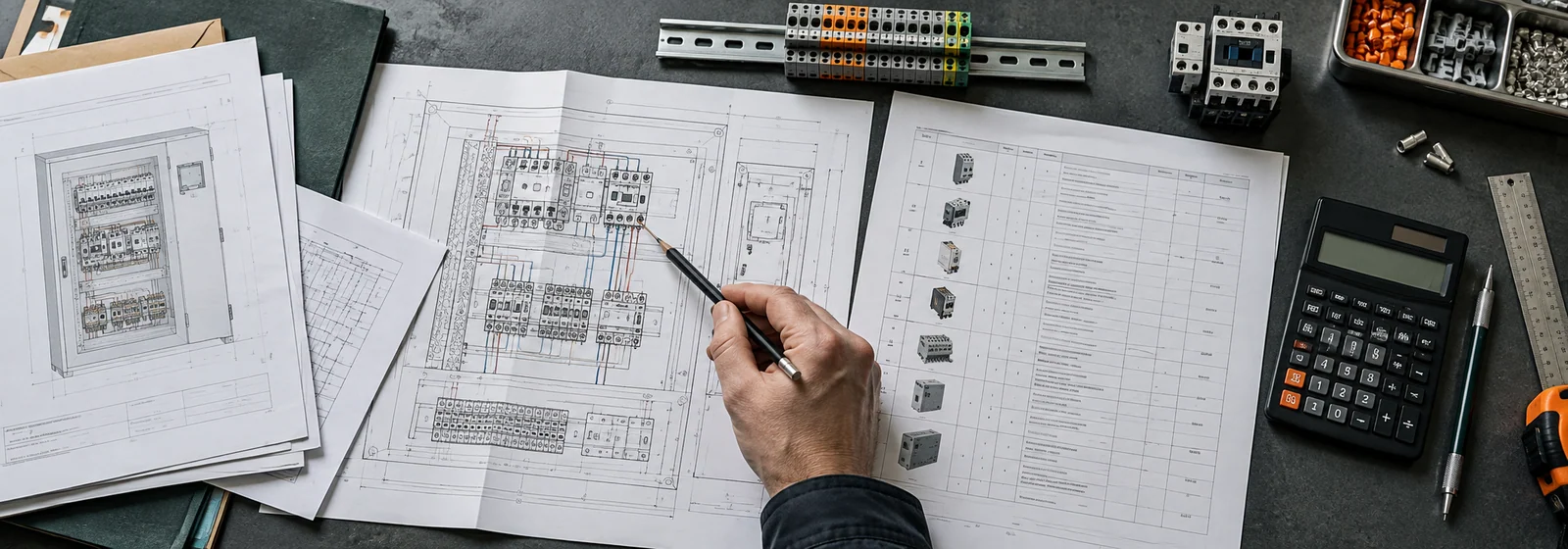 Quoting · 7 min read
Quote a control panel without leaving money on the table
Eight steps from RFQ check to bill of materials, labour and margin, with a second review before it goes out.
Read the guide ↗ AI and quoting · 6 min read
Don’t buy AI quoting software until you’ve run this test
Test AI quoting software on your own past quotes, not a vendor demo, and see which one holds up before you commit.
Read the guide ↗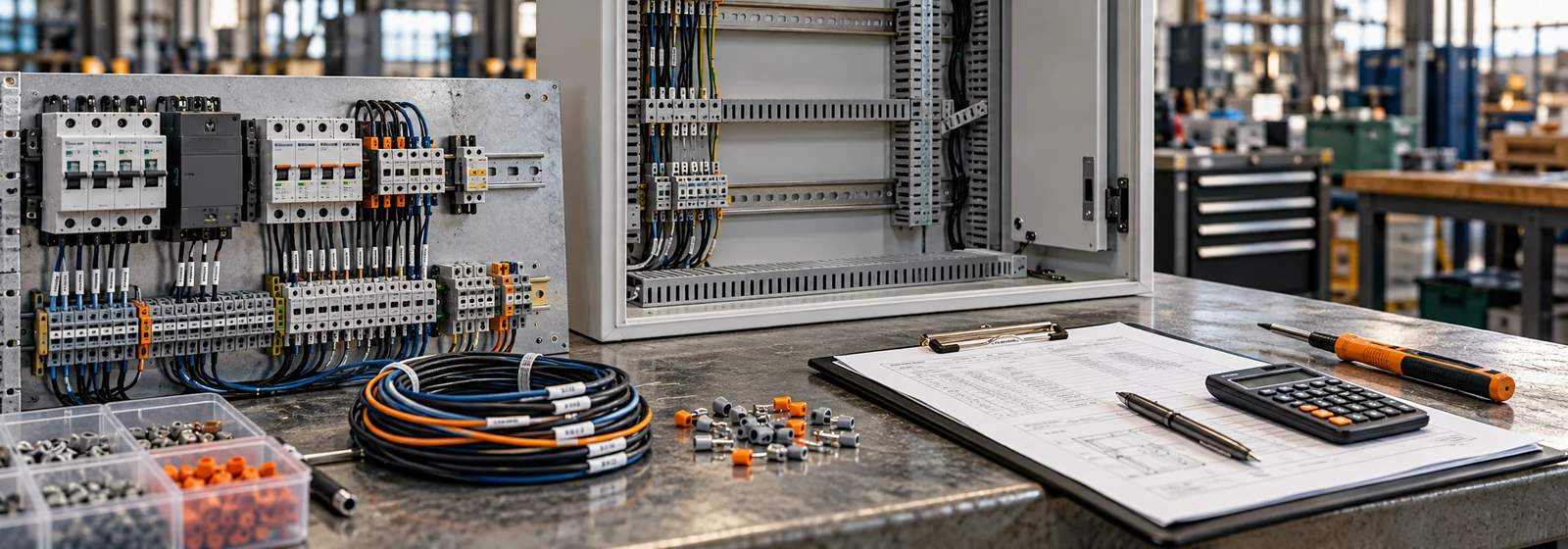 Estimating · 6 min read
A 25% markup is not a 25% margin. Price your panels correctly
See why a 25% markup is not a 25% margin, and how to build the cost, markup and margin layers correctly.
Read the guide ↗Other jobs we can
take off your team.
Quote preparation is where we start. The others are planned next, shaped with our first partners. Have a different job in mind? Bring it to us.
 NEXT02 / PRICE
Price and lead-time alerts
Flag quotes that go stale when component prices or lead times move.
Catch stale quotes ↗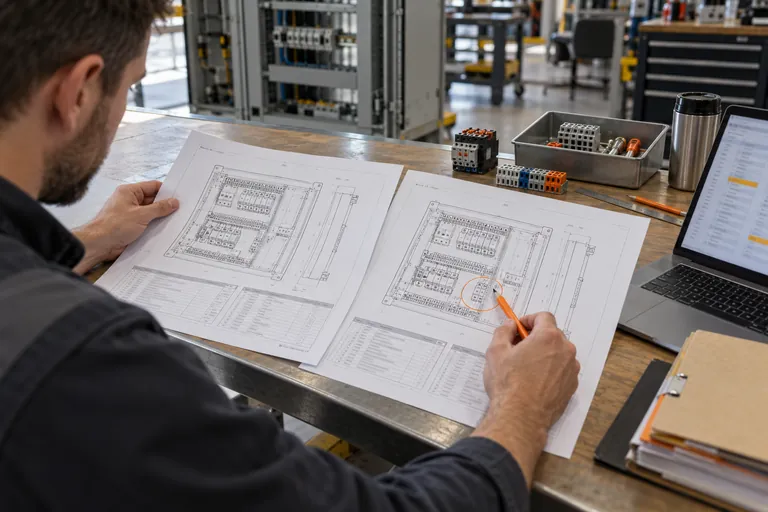 NEXT03 / CHANGE
Revision tracking
Catch changed quantities and part numbers and carry them through.
Track every change ↗ NEXT04 / BUY
Purchasing checks
Check the BOM against the purchase order before parts are ordered.
Check before you buy ↗ NEXT05 / PROVE
UL 508A documentation
Prepare the compliance paperwork from job data, for your team to check.
Prepare the paperwork ↗