
Don’t buy AI quoting software until you’ve run this test
AI quoting software for manufacturers: how to evaluate it before you buy
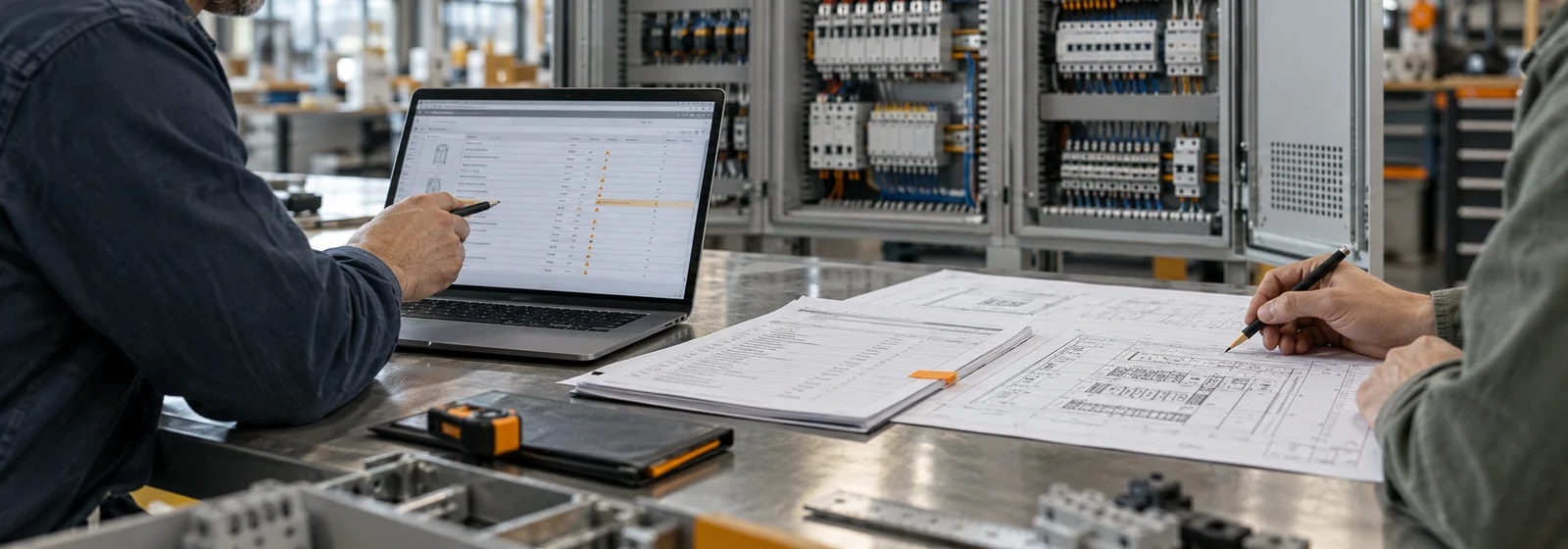
Evaluate AI quoting software by testing it on your own past quotes, not on a vendor demo. Measure line-level accuracy, how often it flags exceptions, how long a reviewer needs to approve a quote, and whether a named person can still override every result. Then check integration, data handling and total cost against a ten-question scorecard.
- Test on your own history: run 10 to 20 past quotes where you know the right answer.
- Judge accuracy line by line, and judge the exception list too. Knowing what it is unsure about is half the value.
- A person should approve every quote. Ask exactly where in the workflow that happens.
- Ask where your drawings and prices go, who can see them and whether they are used to train anything.
- Treat headline results from vendors, including revenue-uplift claims, as unverified until you see them on your data.
Search for software that can speed up quoting and you will find three overlapping things: configure, price, quote tools (CPQ), quoting modules inside an ERP, and a newer group of products that use AI to read incoming RFQs and drafts. They solve different problems. CPQ works best when the product is configurable from a defined catalogue. AI-assisted quoting is aimed at the other end of the spectrum, where each job arrives as drawings, spreadsheets and email attachments and has to be interpreted before it can be priced. Custom panel building sits firmly in that second group. This guide is about how to evaluate that kind of tool without being swayed by a polished demo.
What AI quoting software should, and should not, do
A useful way to think about it is preparation versus decision. Preparation is reading the package, extracting the lines, matching them to your part library and price lists, and drafting a priced quote. Decision is everything that carries professional or commercial judgement: whether a part is suitable, whether a design meets the standard, what margin to take, whether to bid at all. Good AI quoting software does the first and leaves the second to named people, with a clear record of what it did. If a vendor describes the product as removing the estimator, treat that as a warning. In an engineered-to-order business the quote is a commitment, and someone qualified has to own it.
A ten-question scorecard
Score each question from 0 to 2: 0 for a poor or missing answer, 1 for partial, 2 for a clear answer you have seen demonstrated on your own material. A total below about 14 out of 20 is a reason to keep looking or to narrow the scope.
Evaluation scorecard
- Accuracy: can the vendor show line-level accuracy on documents like yours, not just clean sample files?
- Exceptions: does the tool list what it could not read or match, rather than guessing quietly?
- Sources: can every extracted line be traced back to the page or cell it came from?
- Human approval: where exactly does a person review, correct and approve before anything leaves the shop?
- Your rules: can your pricing, labour and margin rules be applied, and changed by you?
- Integration: does it work from the files you already export, and what would be needed to connect it to your ERP later?
- Data handling: who can see your drawings and prices, where are they stored, and are they used to train models for others?
- Pilot terms: can you test on your own past quotes before committing, and are the success measures agreed in writing?
- Total cost: are setup, subscription, per-quote fees and support itemised and predictable?
- Continuity: what happens to your quotes and data if you leave, and who supports the product long term?
The first two questions matter most. A tool that looks right 95 percent of the time but cannot tell you which 5 percent to check is more dangerous than one that is right 85 percent of the time and flags the rest. In practice, reviewers learn to trust the flags. When they cannot see them, they either re-check everything, which removes the time saving, or stop checking, which removes the safety.
How to run a pilot on your own past quotes
The most reliable test is a retrospective one. Pick 10 to 20 quotes you have already completed, ideally across a spread of difficulty: some clean packages, some messy ones, a few with revisions. Remove the answers. Run the packages through the tool, then compare its output with what your estimator actually produced.
- Agree the success measures in writing first: line-level accuracy, share of quotes within an agreed price tolerance, exception rate, reviewer minutes per quote, and number of corrections.
- Score line by line, not just the total. Two offsetting errors can produce a correct total and still hide a bad process.
- Record the reasons for every miss: unreadable source, wrong part match, missing price, rule not applied.
- Time the review. The saving that matters is the time from package received to approved quote, including the reviewer's time.
- Repeat on a second batch after adjustments, so you can see whether the tool improves with your feedback.
A pilot is a measured loop, not a demo.
- 1Run past quotesUse finished jobs where you already know the answer
- 2CompareTool output against your actual quote
- 3Record findingsWhy each miss happened
- 4AdjustFix the cause, not the symptom
- 5Try a fresh batchJobs the tool has not seen
Do the agreed measures hold on the fresh batch? If yes, extend the pilot. If not, go back to step 3 and repeat.
- Missed items
- Incorrect flags
- Reviewer time per quote
Agree the measures and what counts as passing before you start, and keep the fresh batch separate from the jobs used to tune the tool.
Also compare against realistic baselines. HumCommerce, a vendor of quoting automation, reports that building a standard quote by hand takes 40 to 75 minutes and that custom work takes 48 to 120 hours to turn around because of engineering review. Those are a vendor's benchmarks, not a standard, so measure your own current time per quote before the pilot. Without that baseline you cannot say whether a tool saved anything.
Questions to ask about data and security
Drawings and prices are among a shop's most sensitive assets. Ask for a non-disclosure agreement before sharing anything, and ask the following in plain terms: where is the data stored, who at the vendor can see it, how long is it kept, how is it deleted, and is it used to improve models that serve other customers. Some vendors improve their products using patterns learned across customers while keeping each customer's data separate. Others do not. Either can be acceptable, but you should know which applies and have it in writing. Drawings and price lists should not be sent through a web form before the agreement is in place.
Use a risk framework to structure the decision
If you want a neutral structure for the evaluation, the US National Institute of Standards and Technology published its AI Risk Management Framework (AI RMF 1.0) in January 2023. It organises AI risk work into four functions: Govern, Map, Measure and Manage. Applied to quoting, that translates naturally. Govern means naming an owner for the tool and agreeing who may change its rules. Map means writing down what the tool touches, what data it reads and what decisions it influences. Measure means testing it on your own inputs and tracking error rate, exception rate and override rate. Manage means having thresholds that trigger action, the ability to pause the tool, and records that let you reconstruct how a given quote was produced. You do not need a formal programme to benefit from the same discipline.
Red flags
- A demo that uses only clean, vendor-chosen files and will not run one of yours.
- No list of exceptions or uncertainty: every line is presented as confident.
- Claims of fixed percentage gains in revenue or margin with no baseline or method. One CPQ selection guide, for example, repeats a claim that many manufacturers saw a 35 percent revenue increase within a year without defining the baseline, which is exactly the kind of figure to ask to see on your data.
- Unclear data terms, or a refusal to put them in the contract.
- Hidden costs: setup fees, per-seat or per-quote charges and integration work that are not itemised.
- No way to export your rules and data if you leave.
Integration: start small, plan the path
A common selection guide for manufacturers makes the sensible point that integration claims should be verified, not assumed: ask for evidence of working integrations with systems like yours. For a custom panel shop, a pragmatic path is to start from the files you already export and the quote format you already use, prove the value there, and add ERP connections only if the numbers justify them. Tying a first pilot to an integration project makes it slower, dearer and harder to judge.
What a good outcome looks like
A good result is not a robot that quotes. It is an estimator who spends the morning reviewing two prepared quotes with a short exception list, instead of building one from a stack of PDFs. Quotes go out faster, the review is consistent, and the rules your shop has built over years are applied every time. If you want to see how we approach this for panel shops, our quote preparation workflow is built around exactly this loop: source-linked extraction, a priced draft, an exception list, and your estimator approving the result, tested on your past quotes first. It sits within the wider Steady Rabbit AI practice for panel manufacturers. If you are still working out your own process first, start with our control panel quoting checklist.
Frequently asked questions
What is AI quoting software?
AI quoting software uses machine learning to read incoming requests for quotation, such as drawings, spreadsheets and emails, extract the line items, match them to your parts and prices, and draft a quote for a person to review. It differs from CPQ, which configures a quote from a defined product catalogue.
What is the difference between AI quoting and CPQ?
CPQ configures, prices and quotes products from a predefined catalogue and rules, so it suits standard or configurable goods. AI quoting is aimed at engineered or custom jobs that arrive as unstructured documents and must be interpreted before they can be priced. Some tools combine both.
How accurate is AI quoting software?
It depends on your documents. Clean PDFs and structured BOMs are the easiest; hand-marked scans are harder. Ask for line-level accuracy measured on your own past quotes, and for an exception list showing what the tool could not read, instead of relying on a single headline percentage.
Can AI replace an estimator in a manufacturing shop?
No. In engineered-to-order work the quote is a commitment, so a qualified person should review, correct and approve it. The realistic benefit is that the estimator spends less time reading packages and looking up prices, and more time on judgement and on winning the work.
How do I pilot quoting automation without risk?
Run 10 to 20 completed quotes through the tool with the answers hidden, then compare line by line against what your estimator produced. Agree success measures in writing first, sign a non-disclosure agreement before sharing data, and make any subscription start only after you have signed off the result.
Is my pricing and drawing data safe with an AI quoting vendor?
It depends on the vendor, so ask in writing: where data is stored, who can access it, how long it is kept, how it is deleted and whether it is used to train models for other customers. Insist on a non-disclosure agreement before sharing any drawings or prices.
Sources
- NIST: Artificial Intelligence Risk Management Framework (AI RMF 1.0) — Publisher of the framework, released January 2023: Govern, Map, Measure, Manage.
- Kognitos: NIST AI Risk Management Framework in operations — Secondary source used for the operational reading of the four functions.
- HumCommerce: How Long Should a B2B Quote Take? — Vendor article. Manual quote time and turnaround ranges; caveats noted above.
- GenAlpha: Select the Right CPQ Vendor, a Step-by-Step Guide for Manufacturers — Vendor article. Selection criteria, red flags, pilot advice and the unverified 35 percent revenue claim.
Prepared by the Steady Rabbit AI team from the published sources above. Figures and ranges from third parties are as reported by them and are not Steady Rabbit measurements. This is general information, not engineering, legal or compliance advice. Check current requirements and supplier data for your own jobs.
Where this fits in our workflows.
More guides for panel shops.
 Quoting · 7 min read
Quote a control panel without leaving money on the table
Eight steps from RFQ check to bill of materials, labour and margin, with a second review before it goes out.
Read the guide ↗ Estimating · 6 min read
A 25% markup is not a 25% margin. Price your panels correctly
See why a 25% markup is not a 25% margin, and how to build the cost, markup and margin layers correctly.
Read the guide ↗ Revisions · 6 min read
One changed line can derail a panel build. Here’s how to catch it
Learn how a formal change order catches every changed line and keeps BOM and drawings aligned.
Read the guide ↗