
Know when an open quote
has gone stale.
Prices and lead times move. We watch the data you give us and flag open quotes that are affected, so your estimator can decide whether to re-quote.
Planned · shaped with our first partners

- WE READOpen quotes inYour sent quotes and their BOMs
- WE WATCHPrices and lead times watchedAgainst the data you provide
- WE FLAGAffected quotes flaggedThe lines that moved, with sources
- YOUR ESTIMATORYou decideRe-quote, hold or leave as is
From “sent” to “ordered”,
the quote keeps ageing.
Select a moment to see what happens, and where a quote quietly goes out of date. Each step also shows what it costs you.
Quote goes out
The quote leaves with prices, lead times and a validity period built from the BOM at that moment.
Nothing records which lines carry the most price risk, so later nobody knows where to look first.
Padded quote. A quote that is higher than it needs to be loses to a sharper competitor.
Customer takes time
The customer compares suppliers, waits for approvals and checks budgets. Your quote sits in the pipeline.
There is no routine reason to reopen a quote that has not been answered.
Silent expiry. The customer holds a quote you would not honour, or you honour one you should not.
Prices move
Distributor and manufacturer prices change on their own schedule, often on exactly the parts that dominate the quote.
The change is visible only if someone happens to look at that part number.
Absorbed increase. Margin on the job is quietly given away.
Lead times move
Enclosures, drives, breakers and PLCs can change lead time without notice.
The quote still promises the original date, and the customer plans around it.
Broken delivery date. A missed date, an unhappy customer and expediting costs.
Order arrives
The order lands against the quote as written, sometimes weeks after it was prepared.
The shop learns about the price or date problem only when purchasing starts.
Awkward call. Trust takes a hit, and sometimes the job does too.
Re-quote decision
An experienced person compares old prices with current ones, line by line, and decides whether to reissue.
It is slow, so it happens late, or only for the quotes someone remembers.
Recheck nobody has time for. The most senior people spend hours on it, or it does not get done.
We watch the quotes.
You decide what to do.
Alerts are only useful when they point at a line, a source and a reason.
- Your data stays yours, under an NDA
- You keep your own tools and files
- A person approves every result
Three open quotes are loaded with their BOMs and the price and lead-time data you provided.
| QUOTE | CUSTOMER | VALUE | SENT | VALID FOR |
|---|---|---|---|---|
| Q-2041 | Sample customer A | $18,420 | 21 days ago | 9 more days |
| Q-2043 | Sample customer B | $7,860 | 12 days ago | 18 more days |
| Q-2047 | Sample customer C | $31,200 | 3 days ago | 27 more days |
Each line is compared with your current data. Sample threshold set by your estimator: a price up by more than $15 a unit, or a lead time more than 2 weeks later.
| ITEM | QUOTE | QUOTED | NOW | CHANGE |
|---|---|---|---|---|
| Main breaker 63 A, 4 units | Q-2041 | $184.00 | $203.00 | +$19.00 a unit |
| Drive 2.2 kW, 1 unit | Q-2041, Q-2047 | 3 weeks | 7 weeks | +4 weeks |
| Contactor 25 A | Q-2043 | $62.00 | $62.00 | No change |
| Overload relay 17–25 A | Q-2043 | $48.00 | $48.00 | No change |
Two quotes are affected, ranked by how soon each stops being valid. Q-2043 has no alert.
| RANK | QUOTE | WHAT MOVED | SOURCE |
|---|---|---|---|
| 1 | Q-2041, valid 9 more days | Main breaker +$76.00 on 4 units. Drive lead time +4 weeks. | Your price file; supplier lead-time sheet |
| 2 | Q-2047, valid 27 more days | Drive lead time +4 weeks. | Supplier lead-time sheet |
Your estimator decides for each alert. The decision is recorded.
Waiting for your estimator
Waiting for your estimator
An illustration with made-up parts and prices. Your own version is set up around your files and rules.
Read open quotes
Quotes and their BOMs are loaded with the price and lead-time data you give us or authorise.
Compare to current data
Each line is compared with the data you provide. Changes above your own thresholds are kept.
Raise a ranked alert
Affected quotes are listed with the lines that moved, the size of the change and the source.
Your estimator decides
Re-quote, hold, or leave alone. The decision and its reason are recorded.
A 4–6 week pilot on your own work.
A subscription only once it is proven.
We agree the scope and the definition of done, and sign the NDA together. We run the pilot on your own data and keep refining it until it meets that definition. Your annual subscription starts only after you sign off the result.
- 01START · AGREE THE SCOPE
Agreed up front, in writing.
We sign the NDA and agree the scope together: one workflow, the success measures and exactly what done looks like. Only then do any drawings or prices change hands.
- 02DURING · 4–6 WEEK PILOT
On your own data.
We run the pilot beside your live work, so nothing you rely on changes. A set of open quotes and the price files or sources you already use.
- 03END · SIGN-OFF
Refined until it meets the bar.
A short report against the success measures you set. If it falls short, we refine and run it again until it meets the definition of done.
- 04AFTER · SUBSCRIPTION
Starts at sign-off.
One annual subscription per workflow covers running it, support and improvements. You already know it works on your own data, so this is not an experiment.
How you are protected. The pilot has a bounded scope and success measures agreed before it starts. Concerns about your data, or about how our two teams will work together, are tested against those measures. At the end you decide whether to go on, and the subscription starts only after you sign off.
Why panel shops
work with us.
Your data stays yours. The workflow gets better every year, for you and for everyone we work with.
Your data stays yours
Your drawings, prices and quotes are covered by the NDA and are never shared with other shops. Access, storage and deletion are agreed up front.
You get the best of every shop
What we learn about the work itself, the common gaps and the checks that catch them, goes back into the product. You benefit from it without anyone seeing your data.
It keeps getting better
We keep refining the format, the checks and the results throughout the year. Improvements to your workflow are included in your subscription.
You see it work first
The pilot runs on your own quotes against a definition of done you set. You subscribe once you have signed off the result.
We run it. You decide.
We set it up, run it and support it. Your team reviews and approves everything that reaches a customer.
Built by AI product engineers
AI product engineering is what we do every day, and that craft goes into your workflow: the design, the testing and the support.
Alerts that earn their place
on your estimator’s screen.
Every alert is traceable to a source, and nothing changes a customer’s quote on its own.
Price changesWhat moved, and by how much.4 checks
- Line price compared with the price on the quote
- Change measured against your own threshold
- Source and date of the new price shown
- Currency and unit consistency checked
Lead timesWhether the promise still holds.4 checks
- Lead time compared with the promised date
- Longest-lead line identified for the quote
- Change in lead time shown with its source
- Parts without lead-time data listed
ValidityQuotes approaching expiry.3 checks
- Validity date tracked per quote
- Quotes nearing expiry listed in advance
- Quotes already expired listed separately
Source and freshnessHow current the data is.3 checks
- Age of each price or lead-time record shown
- Lines with stale or missing data marked
- Source file or system named on every alert
RelevanceAlerts that deserve attention.3 checks
- Alerts ranked by value at stake
- Small movements below your threshold suppressed
- Repeat alerts on the same change collapsed
Record of decisionsWho decided, and why.3 checks
- Re-quote, hold or ignore recorded per alert
- Reason and reviewer saved with the decision
- History available for the next time the quote moves
Tap a card to see the checks.
What a flag looks like · sample
Main breaker line, cost has increased
Current price is above the quoted price. Source and date shown. Margin on the line has changed.
Drive, delivery now later than promised
Quoted date assumed a shorter lead time than the data now shows.
Quote validity ends soon
Validity date approaches with no customer response recorded.
What we will not do · boundaries we keep, on purpose
Scope, input, output and boundaries
Your open quotes with their BOMs, and the price and lead-time data you provide or authorise
An alert list of open quotes whose cost or lead time has moved, with the lines affected
Your estimator decides whether to re-quote
A set of open quotes and the price files or sources you already use.
Alerts raised against changes your team agrees were real, false alerts, and time to review.
Supplier prices and availability depend on the data you provide or authorised sources. We do not guarantee a supplier’s price or stock.
What buyers ask
before they start.
How do component price alerts work for open panel quotes?
This workflow is planned. The idea is simple: compare the price and lead time on each line of a quote with the latest price data you give us, and flag the quotes where a line has moved enough to matter. You decide whether to reprice.
Which price and lead-time data does it need?
The distributor price files, supplier quotes and exports you already receive. We sign an NDA first. No distributor or supplier integration is implied by this website; any live feed would be scoped separately.
How do you know when a panel quote has gone stale?
You set the rules with us: for example the quote validity date, a price move beyond a threshold, or a lead time that slips past what you promised. The workflow applies your rules and shows which lines tripped them.
Can AI predict component price increases?
No. It flags changes that have already shown up in the data you provide. It does not forecast the market.
Does someone decide whether to reprice or requote?
Yes. The alert tells your team what changed and on which quote. Your estimator or sales lead decides what to do, and nothing is sent to a customer automatically.
Is price and lead-time alerting available now?
It is planned next and is being shaped with our first partners. Quote preparation is where we start. If this one matters most to you, tell us, because it helps set the order.
See what it could take
off your team.
A 20-minute call. We listen first, walk you through it, and tell you whether it fits. No drawings needed.
Guides behind this workflow.
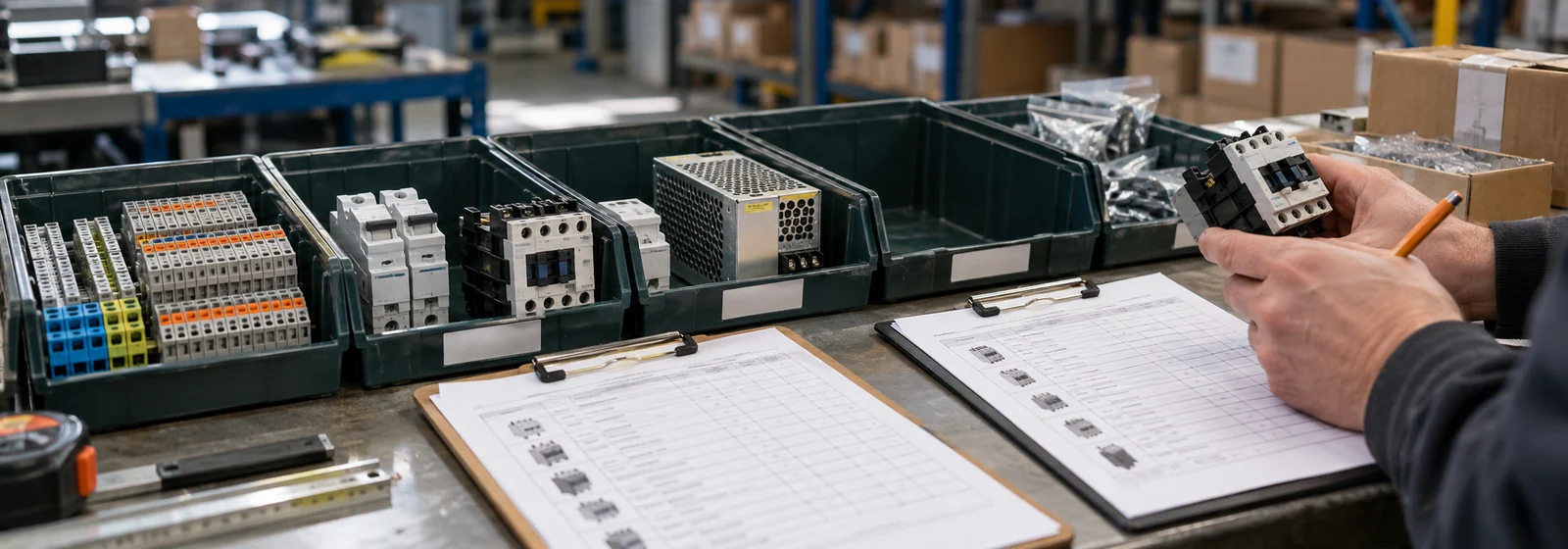 Purchasing · 6 min read
Check the BOM against the PO before the wrong part is ordered
Compare the BOM, the quote and the purchase order line by line, so the wrong part is caught before it is ordered.
Read the guide ↗ Estimating · 6 min read
A 25% markup is not a 25% margin. Price your panels correctly
See why a 25% markup is not a 25% margin, and how to build the cost, markup and margin layers correctly.
Read the guide ↗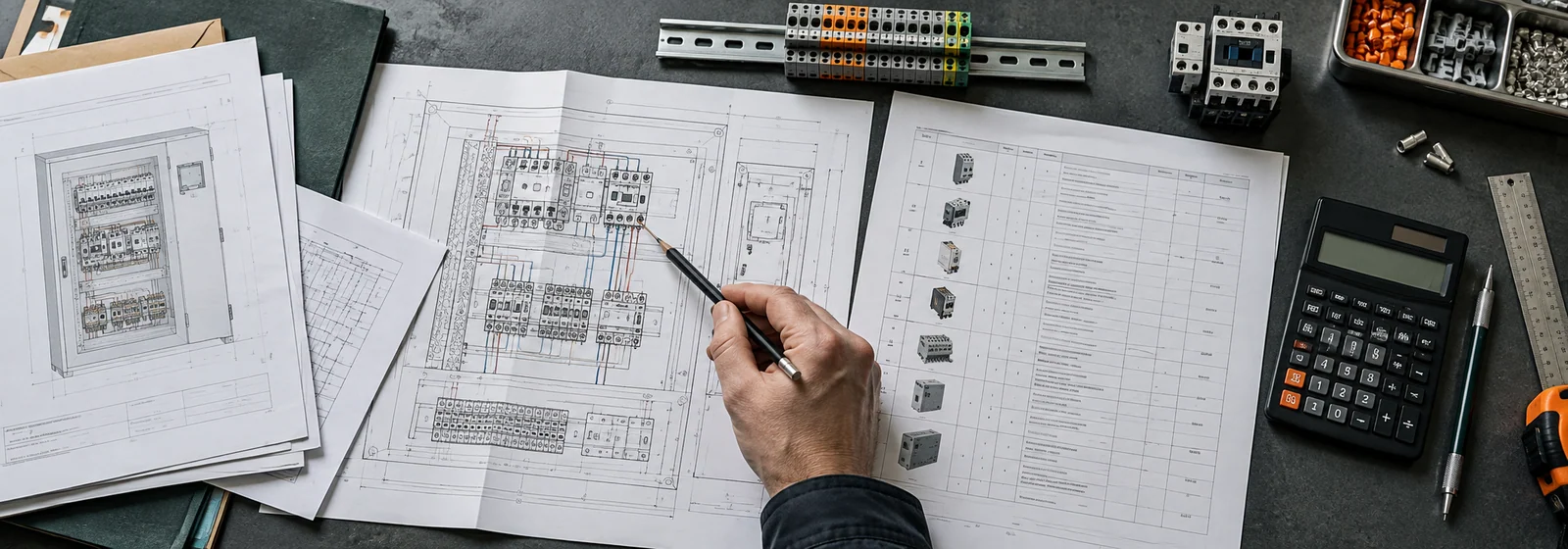 Quoting · 7 min read
Quote a control panel without leaving money on the table
Eight steps from RFQ check to bill of materials, labour and margin, with a second review before it goes out.
Read the guide ↗Other jobs we can
take off your team.
Quote preparation is where we start. The others are planned next, shaped with our first partners. Have a different job in mind? Bring it to us.
 START HERE01 / QUOTE
Quote preparation
Turn an RFQ into a reviewed BOM and a priced draft quote.
Prepare quotes faster ↗ NEXT03 / CHANGE
Revision tracking
Catch changed quantities and part numbers and carry them through.
Track every change ↗ NEXT04 / BUY
Purchasing checks
Check the BOM against the purchase order before parts are ordered.
Check before you buy ↗ NEXT05 / PROVE
UL 508A documentation
Prepare the compliance paperwork from job data, for your team to check.
Prepare the paperwork ↗