
Is your UL 508A documentation pack complete?
UL 508A documentation checklist for panel shops: what to produce and keep
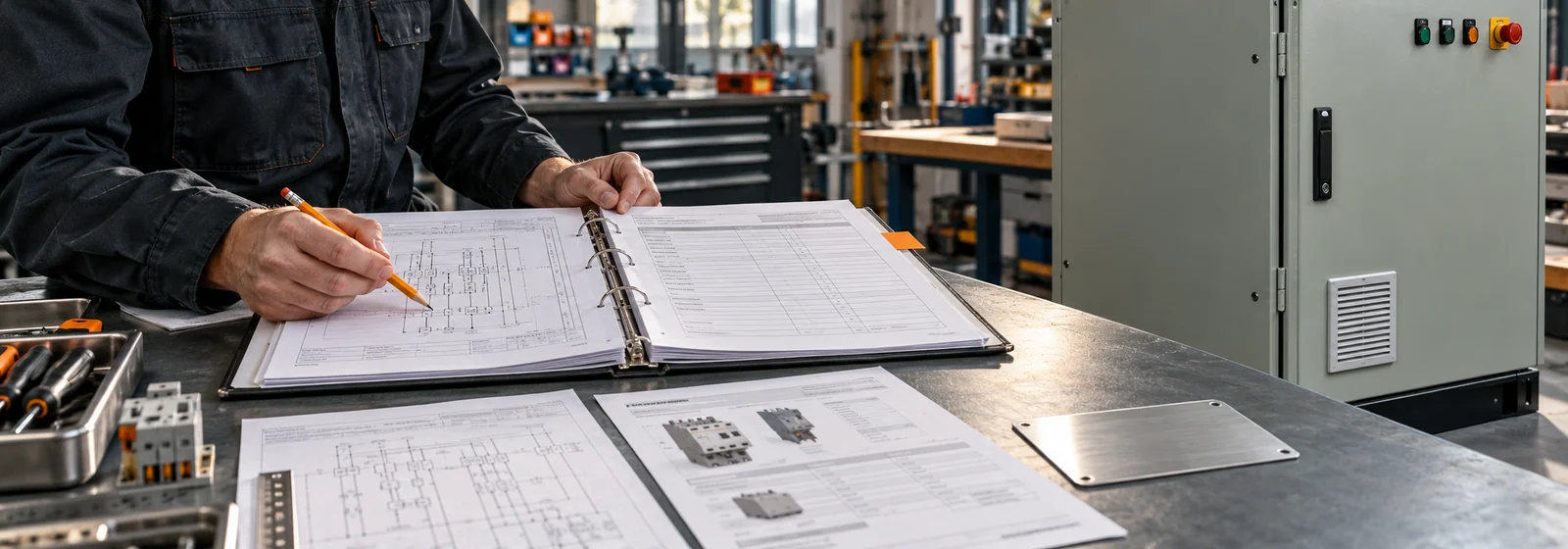
For each UL 508A panel, a shop should produce and keep circuit diagrams that reference the installed components, a bill of materials with part and file numbers, the short-circuit current rating (SCCR) calculation, proof of the enclosure type rating, test and acceptance reports, and the nameplate data, with traceable records of the components actually installed. Confirm the current edition and your programme rules with UL Solutions.
- The documentation pack is built from the design: schematic, BOM, SCCR calculation, enclosure rating, nameplate and test records.
- The SCCR is set by the weakest component in each circuit section and must be marked on the nameplate.
- Check Listed versus Recognized components, and verify each one against UL's own database, not just a datasheet.
- Records must be traceable to the as-built panel, including serial numbers and the archived project file.
- This is general information. Confirm requirements with UL Solutions and your qualified technical representative.
UL 508A is the US standard for industrial control panels, and its practical effect on a panel shop is mostly about paper. The panel itself has to be built correctly, but a shop proves that it was built correctly through documentation: what was designed, what was installed, how the short-circuit rating was determined and what was tested. Documentation done properly is also the thing that makes inspection routine and field acceptance smooth. Done badly, it is the reason panels are delayed, re-labelled or red-tagged at site. This checklist sets out what the documentation pack should contain, where the common traps are, and how to keep records so they stay consistent as designs change.
A note before we start. This article is general information drawn from published sources, not compliance advice. UL 508A is a controlled standard that is revised, and programme rules are set by UL Solutions and your qualified manufacturer technical representative. Confirm the applicable edition and requirements with them before relying on anything here.
What the UL 508A panel shop programme is
According to UL Solutions, its Industrial Control Panel Shop Program lets members apply the UL Mark to industrial control panels at their own facility, rather than certifying each panel separately. It covers panels evaluated to UL 508A for the US and Canadian markets, and the areas it evaluates include component usage, enclosure environmental ratings, wiring and motor protection, safety markings and conformance to the National Electrical Code. UL states that each manufacturing location must keep at least one qualified manufacturer technical representative (MTR) on staff, and that manufacturers entering the programme must complete mandatory UL 508A training. The programme page also notes that it helps minimise red-tagged panels at job sites, with the delays and costs that follow. That last point is the practical motivation for getting documentation right.
The documentation pack, panel by panel
One published guide to UL 508A from Unitechnik lists the documentation and evidence behind a compliant panel. Another, from Saphira, says each labelled panel needs a label showing its electrical ratings, SCCR and the shop's UL file number, plus a bill of materials, layout drawings, wiring diagrams and calculation sheets, kept for every labelled panel and reviewed during audits. Combined, a sensible pack looks like this.
One pack per panel: six records that must agree.
- Circuit diagramsMatch the installed components, at the correct revisionRevision: __ Source: __
- Bill of materialsPart numbers and listing file numbers agree with the diagramsRevision: __ Source: __
- Layout and wiringMatch the as-built panelRevision: __ Source: __
- SCCR calculationMethod, circuit sections and weakest component shownRevision: __ Source: __
- Component listingsListing evidence held for each listed partEvidence gap (example): one part has no listing record
- Label and recordsNameplate, serial number and test record agreeRevision: __ Source: __
Illustrative layout. The pack supports review by a qualified person; it does not certify a panel. Orange marks a record that is missing or does not match.
Documentation pack checklist
- Circuit diagrams that reference the actual installed components, at the correct revision
- A bill of materials with part numbers, UL file numbers and the certification documents for each listed component
- The SCCR calculation, showing the method, the circuit sections and the weakest component in each
- Proof of the enclosure type rating, including any cut-outs or modifications that could affect it
- Test and acceptance reports from final inspection and testing
- The nameplate design: manufacturer, voltage, frequency, phases, current, SCCR and maximum ambient temperature
- Panel layout and wiring documentation, including wire lists where used
- Warning labels and operating instructions, in English for the US market
- A traceable record of the components installed, tied to the panel serial number
- The archived project file, kept for the retention period your programme requires
Getting the SCCR right
The short-circuit current rating is the number most likely to catch a shop out. It states the highest fault current the panel can safely withstand, and it must appear on the nameplate. The Unitechnik guide explains the required value depends on the short-circuit current available at the installation site, which you should obtain from the customer before design begins. The method it describes, following UL 508A Supplement SB, divides the panel into circuit sections, lets the weakest component in each section set that section's value, and carries the results through the supply, feeder and branch circuits. Current-limiting protective devices can be factored in. The typical weak points it lists are terminal blocks, switching power supplies, variable frequency drives, motor branches, surge protection devices and instrument transformers. European-style components often have SCCR values too low for the panel, so check them early rather than at the end.
SCCR workflow checklist
- Get the available fault current from the customer or site before the design is fixed
- Divide the panel into circuit sections and list every power component in each
- Record each component's SCCR from its listing documentation, not an assumption
- Identify the weakest component in each section and the resulting rating
- Evaluate whether current-limiting devices can raise the rating, and document why
- Compare the result with the site requirement, and redesign or change parts if it falls short
- Print the final SCCR on the nameplate and keep the calculation sheet with the pack
Component selection: Listed, Recognized and the traps between them
The Unitechnik guide draws a distinction that confuses many new builders. A UL Listed component is a standalone product with a defined function. A UL Recognized component is only acceptable when built into an associated device under its conditions of acceptability, such as mounting orientation, ambient temperature, conductor sizes and torque. It also stresses that datasheets and manufacturer declarations are not enough: each component's file and category codes should be verified in UL's public databases. It lists several common substitution errors, including branch protection (use UL 489 breakers or UL 248 fuses rather than IEC-characteristic breakers) and conductor type (NEC-type wire such as THHN, THWN or MTW rather than VDE or IEC types). If a customer-specified or imported part is not suitable, the time to find out is during quoting, not after the panel is built.
Records: serial numbers, labels and the as-built panel
Documentation only helps if it describes the panel that was actually built. The Unitechnik guide notes that holders of panel shop listings must keep traceable records of the components installed, a serial number process and an archived project file, and that after installation an authority having jurisdiction may check that the nameplate, SCCR, certification mark and documentation match the as-built configuration. One vendor knowledge-base article describes sticker control in practice, with each label number logged against the panel serial number, and says design approval is needed before labelling. Treat that as a description rather than a rule, and confirm the process with your programme representative. The principle is simple: nothing about a panel should be knowable only from the panel.
Records and traceability checklist
- Each labelled panel has a unique serial number tied to its drawing and BOM revisions
- Label or sticker numbers are logged against panel serial numbers
- Substitutions made during the build are recorded and reflected in the as-built drawings
- The BOM in the pack matches the parts physically installed
- Any design change after approval goes through change control before the panel is labelled
- The project file is archived and retrievable by job and serial number
When designs change, documentation must change with them
Documentation errors very often come from revisions. A drawing changes, a part is substituted, and the BOM, SCCR calculation or nameplate is not updated. A vendor description of the programme says any deviation from an approved design requires re-inspection and re-approval before labelling. Whatever your exact programme rules, the safe practice is to make compliance a mandatory line in every change impact assessment. Our guide to the engineering change order process shows how, and the quoting side is covered in our control panel quoting checklist.
Where software can help, and where it cannot
Assembling a documentation pack is repetitive: the same job data feeds the BOM, the wire list, the nameplate and the SCCR sheet, and it has to stay consistent. Software can prepare those documents from the job data and flag mismatches. It cannot decide whether a design complies. That judgement, along with the sign-off, stays with your qualified people. Our UL 508A documentation workflow is planned on that basis: documents prepared from job data for your team to check, never presented as certified. It sits alongside revision tracking in the Steady Rabbit AI practice.
Frequently asked questions
What documents are required for a UL 508A panel?
Published guides list circuit diagrams that reference installed components, a bill of materials with part and file numbers, the SCCR calculation, proof of the enclosure type rating, test and acceptance reports, and the nameplate design, plus traceable component records and an archived project file. Confirm exact requirements with UL Solutions.
What is SCCR on a control panel?
SCCR is the short-circuit current rating: the highest fault current the panel can safely withstand. It is set by the weakest component in each circuit section, calculated under UL 508A Supplement SB, and must be marked on the nameplate. It needs to be at least the fault current available at the installation site.
How do you calculate the short-circuit current rating of a panel?
Divide the panel into circuit sections, record each power component's rating from its listing, let the weakest component in each section set that section's value, and carry the result through supply, feeder and branch circuits. Current-limiting devices can raise the rating if documented. Check terminals, power supplies and drives first.
What must be on a UL 508A nameplate?
Published guidance lists the manufacturer or responsible party, voltage, frequency, number of phases, current, SCCR and maximum ambient temperature. Warnings and operating instructions for the US market should be in English, and the enclosure type rating should be verified. Confirm the full marking requirements for your edition with UL Solutions.
What is the difference between UL Listed and UL Recognized components?
A Listed component is a standalone product with a defined function. A Recognized component is acceptable only when built into an associated device under its conditions of acceptability, such as mounting, temperature, conductor size and torque. Verify each part in UL's database instead of relying on a datasheet.
Does a design change require new UL 508A documentation?
Yes, the documentation has to be updated so it matches the as-built panel, and programme rules may require re-approval before labelling. Include compliance in every change impact assessment, and confirm the process with your qualified technical representative or UL Solutions.
Sources
- UL Solutions: Industrial Control Panel Shop Program — UL's description of the programme and the UL Mark applied at the shop.
- UL Solutions: Industrial Control Panels and Panel Shop Program — Standards covered, what is evaluated, MTR requirement and training.
- Unitechnik: UL 508A Explained Simply — Documentation, SCCR method (Supplement SB), nameplate data and component recognition.
- Saphira: UL 508A Explained — Vendor article. Per-panel documentation and audit review.
- Industrial Monitor Direct: Becoming a UL 508A Listed Panel Shop — Vendor knowledge base. Sticker control and re-approval; confirm figures and rules with UL.
Prepared by the Steady Rabbit AI team from the published sources above. Figures and ranges from third parties are as reported by them and are not Steady Rabbit measurements. This is general information, not engineering, legal or compliance advice. Check current requirements and supplier data for your own jobs.
Where this fits in our workflows.
More guides for panel shops.
 Revisions · 6 min read
One changed line can derail a panel build. Here’s how to catch it
Learn how a formal change order catches every changed line and keeps BOM and drawings aligned.
Read the guide ↗ Quoting · 7 min read
Quote a control panel without leaving money on the table
Eight steps from RFQ check to bill of materials, labour and margin, with a second review before it goes out.
Read the guide ↗ Purchasing · 6 min read
Check the BOM against the PO before the wrong part is ordered
Compare the BOM, the quote and the purchase order line by line, so the wrong part is caught before it is ordered.
Read the guide ↗